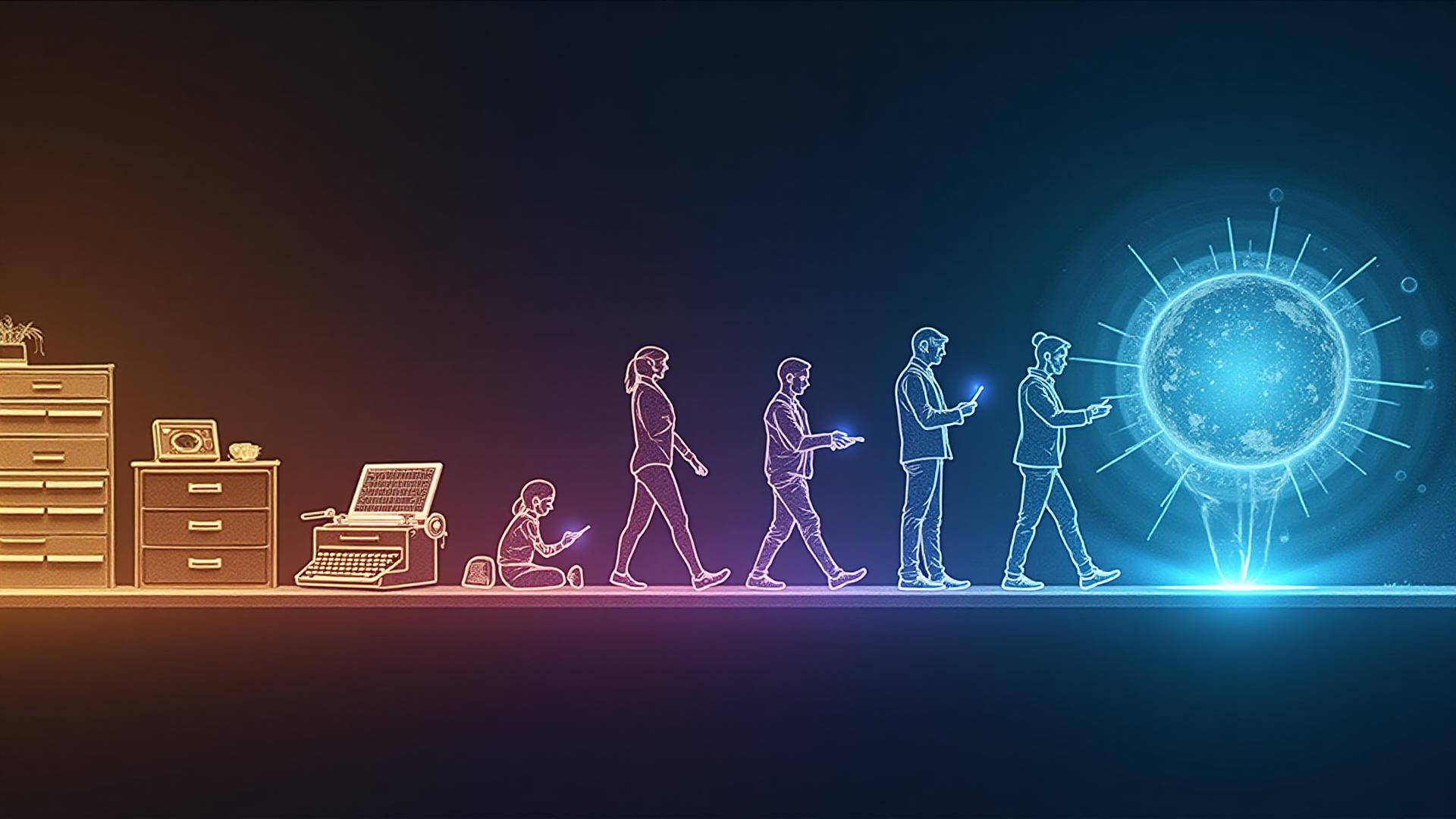
Technology Evolution: Adapt or Become Invisible
History repeats itself for businesses that resist change. Learn why small businesses that don't embrace technology evolution don't just fall behind—they disappear. Discover how to position your business to thrive through technological transformation.
The Technology Adoption Cycle That Separates Winners from Losers
In 1975, Kodak engineer Steve Sasson invented the first digital camera. Kodak executives looked at it, acknowledged its potential, and then deliberately chose to suppress it to protect their film business. We all know how that story ended.
This wasn't stupidity—it was a rational decision by smart people trying to protect a profitable business model. That's what makes it so dangerous. The most devastating business mistakes often feel completely logical at the time.
Today, small business owners are making similar choices about AI and digital transformation. They see the technology, acknowledge its potential, and choose to delay adoption to avoid disrupting what's currently working. History suggests this strategy has one inevitable outcome: invisibility, irrelevance, and eventual extinction.
Why "Wait and See" Has Never Worked in Business
Let's examine the technology adoption cycle that has repeated itself across every major innovation:
Phase 1: The Innovators (2-3%)
Early adopters experiment with new technology. Most fail, but some discover massive competitive advantages. Everyone else watches skeptically, convinced the technology isn't ready.
Phase 2: The Early Majority (13-15%)
These businesses see the innovators' success and adopt proven implementations. They capture significant market share from slower-moving competitors. This is the last phase where adoption still feels optional.
Phase 3: The Late Majority (34-35%)
At this point, adoption becomes mandatory for survival. The technology is now standard customer expectation. Late adopters struggle to catch up while fighting for scraps of market share.
Phase 4: The Laggards (16-18%)
These businesses only adopt when forced by market pressure or regulatory requirement. Most are already in terminal decline. Many never recover their lost position.
The crucial insight: The window between "optional competitive advantage" and "mandatory for survival" is shorter with each technology cycle. For AI, that window is approximately 18-24 months, not years or decades.
The Visibility Crisis: Where Your Customers Actually Are
Your website used to be your digital storefront. Customers would visit, browse, and decide. That era is ending.
The New Customer Journey:
Step 1: AI Conversation
"I need a reliable plumber for an emergency repair. Who should I call?"
AI recommends 2-3 businesses based its knowledge of who's available right now.
Step 2: Verification
Customer asks follow-up questions: "What do they charge?" "Are they available now?" "What do reviews say?"
AI is triggered with buying questions to follow company escalation protocol and get the potential customer connected to a live person immediately. Until that time, no one knows there's even an interaction happening.
Step 3: Action
AI connects customer to the provider in real-time. No answer, option two gets the transfer. And the AI continues until a live person answers the emergency call. The entire time communicating with the customer in need.
Notice what didn't happen: Another missed opportunity. They get what they came for and our speed and dependability earned their business. Imagine if you're the only business who doesn't modernize.
How Small Businesses Win Against Bigger Competitors Through Technology
Here's the counterintuitive truth: small businesses actually have advantages in technology adoption that large corporations lack.
Advantage 1: Decision Speed
You can decide to implement AI tools on Monday and have them running by Friday. Large corporations need committee approvals, IT department coordination, and change management processes that take months or years.
Advantage 2: Nimble Implementation
You can test AI with 10 customers, learn what works, and adjust immediately. Enterprises need formal pilots, risk assessments, and stakeholder buy-in before testing anything.
Advantage 3: Direct Customer Relationships
You know your customers personally. AI tools amplify this relationship rather than replacing it. Big companies use AI to simulate the personal touch you can deliver authentically.
Advantage 4: Lower Legacy System Constraints
You're not trying to integrate AI with 30-year-old mainframe systems. You can adopt best-in-class tools without navigating enterprise IT bureaucracy.
The irony? Large companies fear smaller competitors who move faster with technology, while small businesses fear large companies with bigger budgets. Both fears are justified, but speed beats budget in technology adoption.
Real-World Lessons: Businesses That Chose Invisibility
Blockbuster's $50 Billion Mistake
In 2000, Netflix offered to sell to Blockbuster for $50 million. Blockbuster executives laughed them out of the room. The technology seemed inferior—who wants to wait for DVDs by mail when you can drive to a store?
What Blockbuster missed: Netflix wasn't selling a better distribution method. They were selling a fundamentally different customer experience built on data and convenience. By the time Blockbuster understood this, it was too late to catch up.
The parallel to today: AI isn't just faster customer service—it's a fundamentally different customer experience. Waiting until it's "proven" means waiting until you can't catch up.
Borders Bookstore's Digital Denial
Borders had a thriving business in the 1990s and early 2000s. When e-commerce emerged, they made a fatal decision: they outsourced their online sales to Amazon to "focus on their core strength" of physical stores.
They handed their digital customer relationships to their biggest competitor, assuming physical retail would always matter more. By the time they tried to build their own digital presence, Amazon owned the customer relationship.
The parallel to today: Every day you don't adopt AI, you're training your customers to seek AI-powered experiences from competitors. You're outsourcing your future customer relationships.
Nokia's Smartphone Hesitation
Nokia was the dominant mobile phone manufacturer with 40% global market share in 2007. They saw the iPhone launch and dismissed it as an expensive toy for wealthy consumers. Their phones were more durable, had better battery life, and were more affordable.
They were right about all those things. They were also completely wrong about what mattered. Customers didn't want durable phones—they wanted internet-connected computers in their pockets.
The parallel to today: Your current business model might be efficient and profitable. But if it's not built on modern technology expectations, it's vulnerable to rapid disruption.
The Three Fatal Assumptions
Businesses that become invisible through technology resistance share three common beliefs:
Fatal Assumption #1: "Our Customers Don't Want That"
Your customers don't know what they want until they experience it. No one asked for smartphones, streaming video, or AI assistants. Once they experienced these innovations, going back became unthinkable.
When you say "my customers don't want AI," what you really mean is "my customers haven't experienced AI-powered service from my competitors yet." Once they do, your old approach won't feel like a valid option.
Fatal Assumption #2: "We're Different—Technology Doesn't Apply to Our Industry"
Every industry thinks this. Taxis thought their industry was about regulated medallions and local knowledge, not technology. Then Uber showed that ride-sharing was actually about matching supply with demand through software.
Restaurants thought their business was about food quality, not technology. Then delivery apps showed that convenience and selection mattered more than proximity for a huge customer segment.
What fundamental assumption about your industry is about to be proven wrong?
Fatal Assumption #3: "We Can Always Catch Up Later"
This is perhaps the most dangerous belief. In mature industries, this might be true. In technology-driven disruption, it's almost never true.
The businesses that win capture data, learning, and customer relationships that create compounding advantages. Every month your competitor uses AI, they get better at it while building loyal customers who won't switch to a late adopter offering inferior AI-powered experiences.
The Real Battle: Attention and Trust
Here's what most small business owners miss: You're not competing for customers anymore—you're competing for attention in an AI-mediated world.
Consider this scenario:
A customer asks their AI assistant: "Find me a wedding photographer in Seattle with great candid shots, available in June, under $3000."
The AI evaluates hundreds of photographers and recommends three. How does it choose?
- Structured data it can understand about your services
- Detailed reviews describing specific strengths
- Clear information about availability and pricing
- Portfolio with descriptive metadata
- Responsive communication (your AI chatbot responding instantly builds trust)
If you're not optimized for AI discovery and interaction, you're simply not in the competition. You're invisible.
Your Strategic Choice: Three Paths Forward
Path 1: Lead the Pack
Aggressively adopt AI now. Accept some failures and learning curve. Capture early adopter advantages and customer loyalty before competitors catch up.
Risk: Short-term implementation challenges and costs
Reward: Dominant market position and customer relationships that compound over time
Path 2: Fast Follower
Watch the innovators, learn from their mistakes, then implement proven solutions quickly and effectively.
Risk: Missing first-mover advantages and some early market share
Reward: Better implementation, lower failure rate, still capture significant advantages
Path 3: Wait and See
Delay adoption until "forced" by market pressure or customer demand.
Risk: Permanent market position loss, expensive catch-up costs, potential business failure
Reward: None. You saved some short-term implementation costs while losing long-term viability
The reality: Only Paths 1 and 2 are viable strategies. Path 3 feels safe but guarantees decline.
Making the Invisible Visible: Your Action Plan
Week 1: Visibility Audit
Ask AI assistants about businesses in your category and location. Are you mentioned? How are you described? What are competitors doing differently?
Week 2: Customer Journey Mapping
Track how customers actually find and choose businesses in your industry today. Where are the AI touchpoints? Where are you missing from the journey?
Week 3: Quick Wins Implementation
Implement one AI tool that addresses your biggest visibility gap. This might be:
- AI chatbot for 24/7 inquiry response
- Structured data markup for AI understanding
- Review response automation
- AI-optimized content creation
Week 4: Measure and Expand
Track changes in inquiry volume, response time, and conversion. Use learnings to guide next implementation.
The Uncomfortable Truth
Every business owner reading this has a choice to make. Not choosing is still a choice—it's choosing Path 3, the path that leads to invisibility.
Technology evolution doesn't care about your comfort level, your budget constraints, or your preference for the familiar. It moves forward regardless, reshaping industries and redefining customer expectations.
The businesses that survive and thrive won't be the biggest or the most established. They'll be the ones that recognized the pattern—that technology adoption is not optional in modern business—and acted accordingly.
You can adapt and remain visible, or you can resist and become invisible. There is no third option.
Which path will you choose?
About the Author
QuickMorph Team
Experts in AI-powered business transformation helping small businesses thrive in the digital age.
What this costs, in plain numbers
Builds run $500 to $2,500 once, and $50 a month covers hosting, edits, and monitoring. You own the site. No retainer, no discovery-call gate.